Sunken Driveway Slabs: How Polyurethane Foam Lifts Them Without a Tear-Out
Why driveway slabs drop at the garage door and the street, what a foam lift actually involves, and how to tell a liftable driveway from one that really does need replacing.
Key takeaways
- Most driveway settlement starts with loosely compacted backfill near the garage, or with roof water running under the slab edge.
- Polyurethane lifting raises the slab through ports about 5/8 inch wide, adds almost no weight to weak soil, and usually takes a car again within about 30 minutes.
- Shattered, heaved or badly scaled slabs are better candidates for replacement than for lifting.
- Sealing the joints and moving downspout water away afterwards is what keeps the slab from settling again.
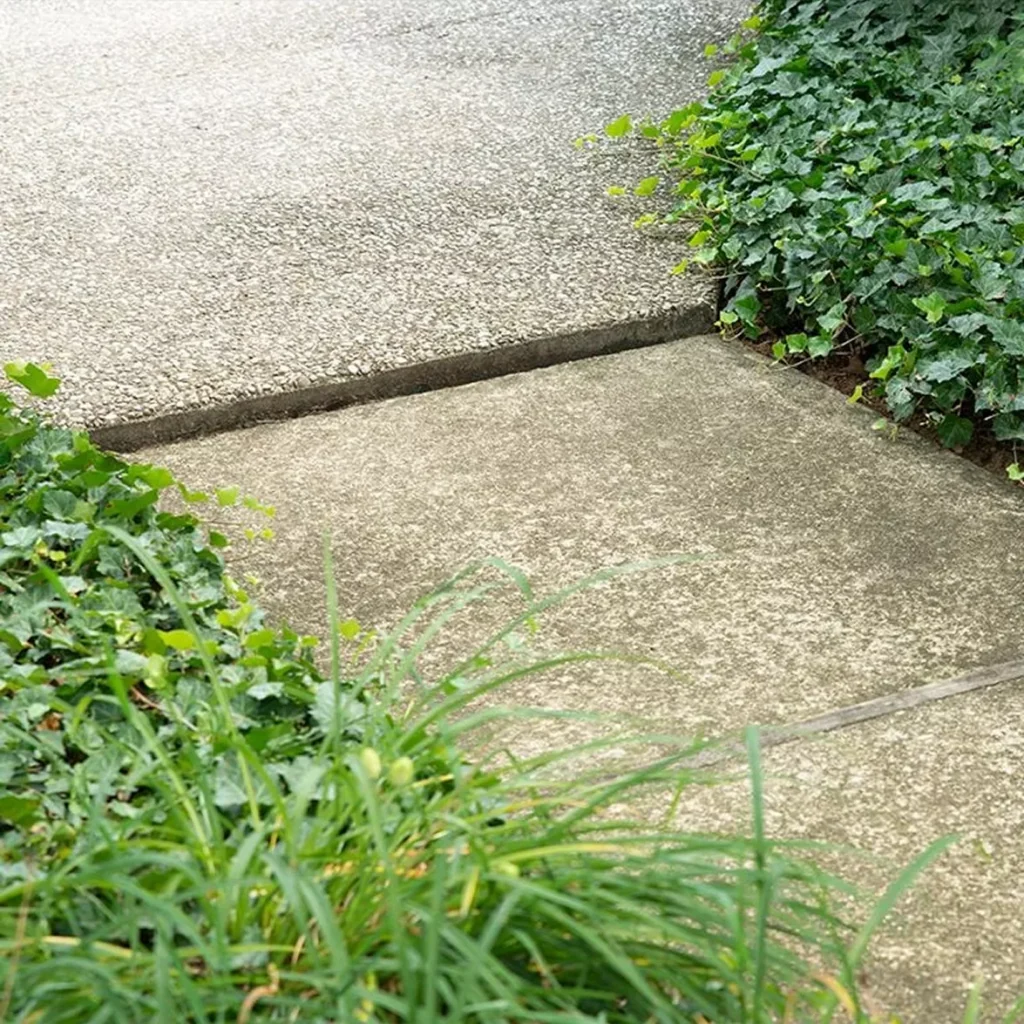
The first sign is usually the garage door. One day the weather seal doesn’t quite meet the concrete, or there’s a lip at the threshold that catches the lawn mower wheel. Out at the street, the apron starts scraping the bumper of anything with a low front end. The driveway hasn’t broken. It has moved — and moved concrete can very often be moved back.
That’s what polyurethane lifting does. A few small holes, two-part foam pumped beneath the slab, and the section floats back up to where it belongs. Here’s how it works on a driveway, where it shines, and where it doesn’t.
Why driveways sink where they do
Driveway slabs rarely sink evenly. They drop at the ends, and the reasons are surprisingly predictable.
- The garage approach sits on backfill. When the house was built, the ground beside the foundation was dug out and later filled back in. That fill is almost never compacted as well as undisturbed soil, so it keeps consolidating for years — and the first slab off the garage goes down with it.
- Roof water finds the edges. A downspout that dumps beside the driveway, or a gutter that overflows onto it, sends water through the joints and along the slab edge. Each time a car rolls over a wet joint, the slab pumps a little fine soil out. Over a few seasons that leaves a void.
- The apron sits on disturbed ground too. Curb work, utility trenches and the occasional delivery truck all conspire against the slab nearest the street.
- Clay soils shrink in dry spells. In expansive clay, a drought can pull the ground away from the underside of a slab, and the slab settles into the gap.
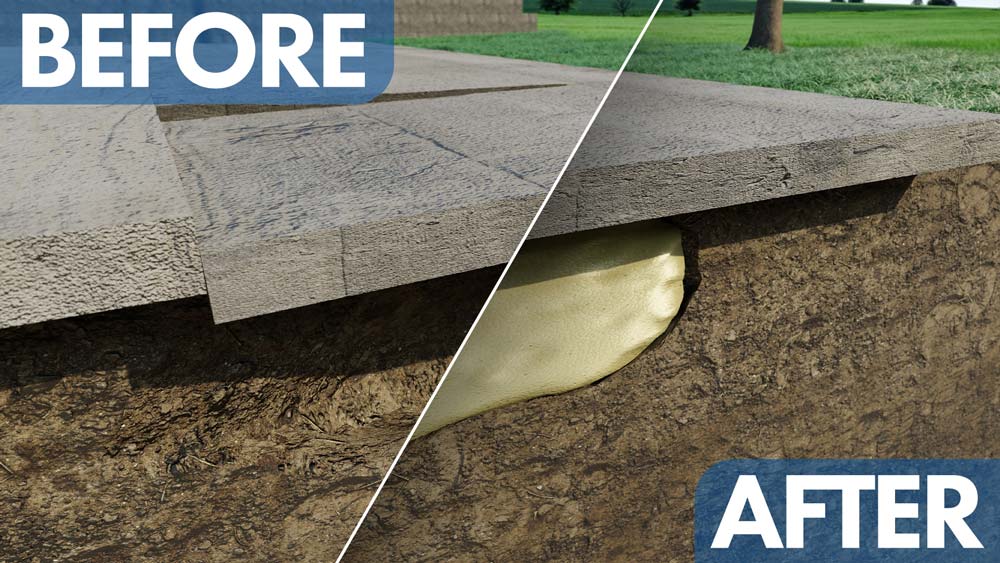
What a foam lift looks like on a driveway
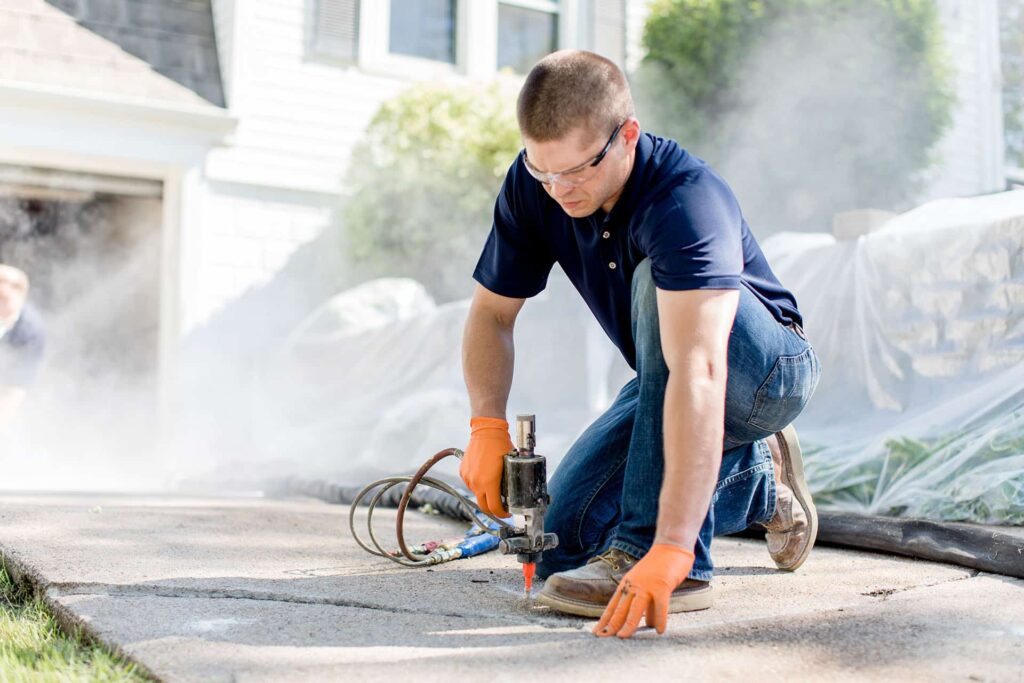
From the curb it’s an unremarkable afternoon: a rig in the street, a hose across the lawn, and one or two people working slab by slab. Up close, the sequence goes like this:
- Read the slab. The tech measures how far each section has dropped, where it’s rocking and where water has been getting in. On a garage approach the goal isn’t just “flat” — it’s restoring a gentle fall away from the house so water drains toward the street.
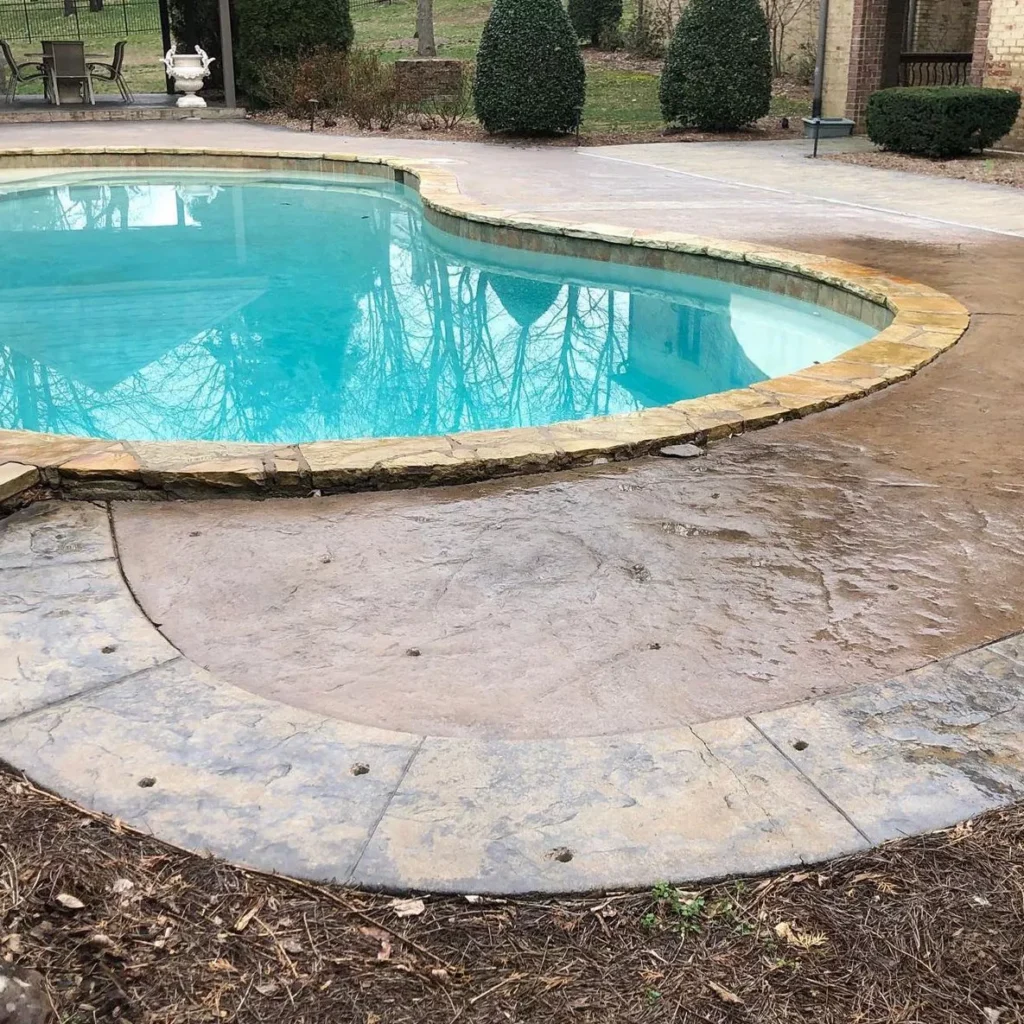
- Drill the ports. Holes about 5/8 inch across go through the slab in a pattern that lets foam push evenly. On a typical residential section that’s a handful of ports, not dozens.
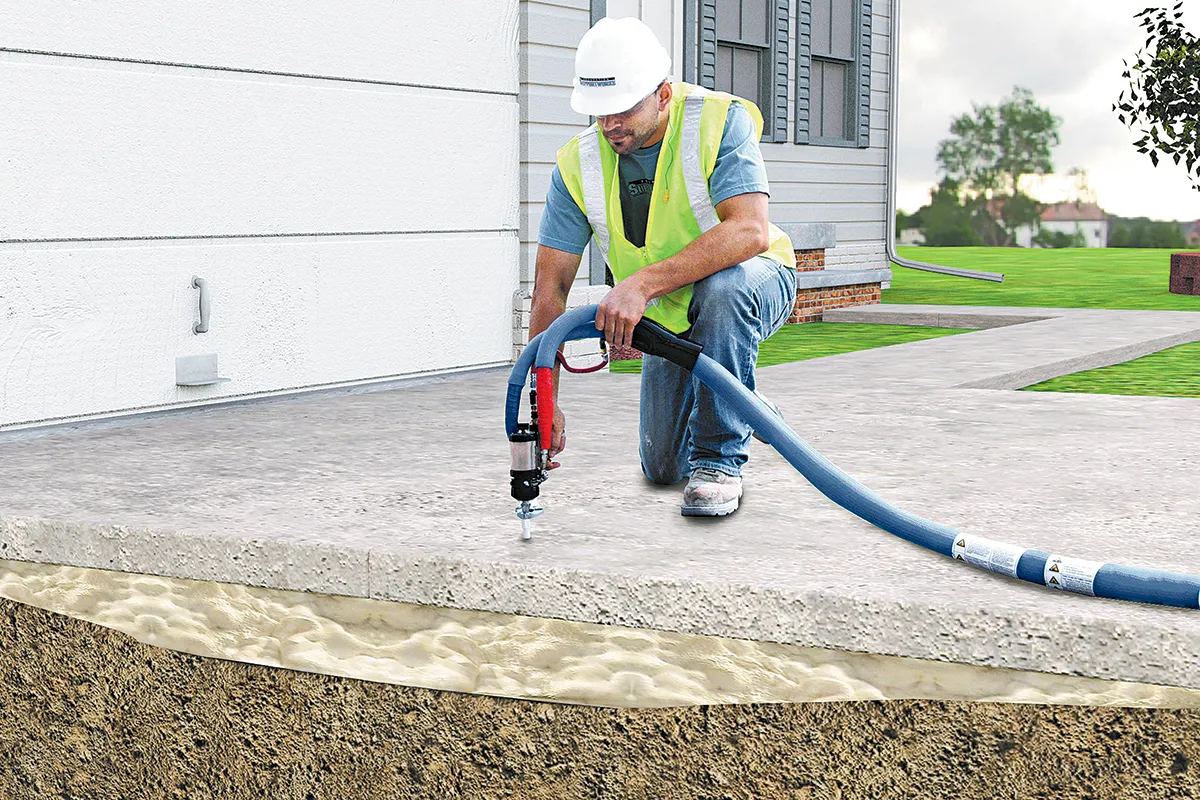
- Inject in short shots. Two-part ArmorFoam Lift is mixed at the gun and pumped under the slab. It fills voids and compacts loose soil first, then starts to raise the concrete.
- Watch, don’t guess. A laser level, a straightedge or dial indicators tell the tech exactly how much each corner has moved, so the slab comes up slowly and stops at the right height.
- Patch and seal. Ports get a cementitious patch. Joints and the gap at the garage slab get flexible sealant so water stops getting in.
ArmorThane rates slabs lifted with Lift 200, its residential foam, to be driven on within 30 minutes or less. Most homeowners are parking in their own driveway the same afternoon.
Why foam beats the alternatives on a driveway
There are three ways to deal with a sunken driveway section: pump something under it, tear it out, or live with it. The case for foam over the other two comes down to weight, time and holes.
That last comparison matters more than people expect. The slab sank because the soil underneath gave up. Adding a heavy grout layer asks that same soil to carry a third more load; adding foam asks it to carry almost nothing extra.
Replacement solves the problem too, but it means demolition, haul-off, base prep, forms, a pour and about a week before you drive on it — plus a new slab that won’t match the color of the rest of the driveway. If the old slab is sound, keeping it is usually the cheaper and faster choice.
When a driveway isn’t a good candidate
Lifting isn’t magic, and a straight answer up front saves everyone a frustrating afternoon. Expect a good estimator to steer you toward replacement or another repair when:
- the slab is shattered into small pieces that can’t be raised as a unit;
- the section has heaved upward from roots or frost — lifting raises concrete, it can’t lower it;
- the surface is badly scaled or spalled, so you’d be lifting concrete that’s failing on top anyway;
- there’s an active leak or washout — a broken drain line under the driveway needs fixing before anything else;
- the slab is tied rigidly into a structure in a way that would crack it if one side moved.
Questions worth asking before you hire anyone
- Which foam are you using, and why that density for my driveway?
- How will you monitor the lift — laser, string line, dial indicators?
- Roughly how many ports per slab, and how will the patches look?
- Will you seal the joints and the gap at the garage slab?
- What does your warranty cover if a section settles again?
Any contractor who’s confident in their process will answer those without hesitating.
Keeping it level once it’s lifted
Foam fixes the void. It can’t fix the water that made the void. A few cheap habits protect the repair for years: extend downspouts so they discharge onto the lawn, not beside the slab; keep the soil along the driveway edges graded up to the concrete; and keep the joints sealed so rain runs off the top instead of down through the cracks. Do that, and the lift you paid for stays where you put it.
Got a garage-door gap or a scraping apron? Request a free estimate and a trained lifting pro will tell you whether your driveway is a good candidate.

About the Lift Report
The Lift Report is the Poly Concrete Lifting guide to polyurethane slab lifting, written with input from the ArmorThane team that manufactures ArmorFoam Lift and the rigs that pump it. Got a correction or a job worth writing up? Tell us.