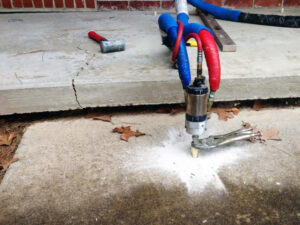
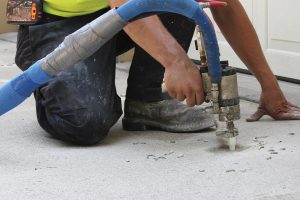
Throughout my years in the leveling industry, I’ve encountered numerous inquiries from homeowners and contractors regarding the ins and outs of this procedure and its suitability for their needs. The essence of leveling is elevating sunken or uneven concrete slabs to their initial state. It serves as a budget option compared to full-fledged concrete replacement and finds extensive use in various settings like driveways, walkways, outdoor spaces, patios, and building foundations.
The Process of Concrete Leveling
In leveling, specific material is injected beneath the current slab to fill any gaps and elevate the concrete back into position; mudjacking and polyurethane foam injection are the main techniques utilized.
In the process of mudjacking—a method— a blend of cement, sand, and water is pressurized to raise the slab to its initial position. Polyurethane foam injection is an innovation that involves injecting a lightweight, fine-density foam that expands and elevates the slab. Both methods aim to rejuvenate the surface without having to demolish and replace the slab.
Based on what I’ve seen so far with these methods in action, the decision on which to go for depends on a few things, like the soil type, what is beneath it all holding up the weight, and how soon you need that spot ready to use. It’s worth noting that polyurethane foam sets quicker compared to mudjacking. This comes in handy for places where speed matters most.
The Expense of Repairing Concrete Surfaces
Cost is a worry for lots of people out there! From my experience in the field, I’ve noticed that fixing concrete is usually cheaper than replacing the slab outright. The prices can differ based on how bad the damage is, the size of the area affected, and the materials used. However, mudjacking tends to be less expensive than using polyurethane foam. Hey! Even though polyurethane might cost a bit upfront, it’s often worth it because it lasts longer and cures quickly, which can be a real lifesaver, especially in high-traffic spots or places that need a tough solution.
When it comes to getting the most out of your investment in fixing concrete surfaces, it can help extend the lifespan of your area and avoid potentially costly repairs in the future. For example, if water gathers on a surface, it might lead to erosion or foundation issues over time that could result in more serious structural concerns.
Methods of Lifting Concrete
Throughout my experience in this field over the years, I’ve come across various techniques; however, two methods that stand out as effective are mudjacking and polyurethane injection. Mud jacking is best suited for heavier slabs commonly found in driveways or garage floors due to its ability to provide a substantial lift despite requiring a longer curing time. On the other hand, polyurethane foam is lightweight, cures quickly, and can be applied to large-scale projects like patios and smaller ones such as walkways.
In my experience with research projects and practical applications, I’ve noticed that selecting the appropriate approach depends largely on the specific needs of the project at hand. Polyurethane has emerged as a favored option owing to its adaptability and robustness. The use of its foam injection technique offers a swift and enduring remedy, which explains its rising appeal in various residential and commercial endeavors.
Questions that often come up regarding leveling
Many people often ask me if concrete leveling has the longevity of freshly poured concrete in a new installation project. The durability of leveled concrete largely hinges on the root cause of the sinking issue that triggered the need for leveling. When the soil under the slab stays firm and steady post leveling work is done correctly. Lasting up to several decades is possible. However,, if soil movements persist requiring leveling, in the future to emphasize the importance of resolving underlying problems before opting for a fix.
People often wonder if the leveling procedure could harm the concrete slab, in place. From what I’ve seen when carried out by skilled individuals, concrete leveling is done with minimal disruption. The small holes made for injecting the leveling substance are easy to cover up leaving the surface looking almost good as new.
During my studies, I’ve encountered worries about whether leveling work can be carried out in other regions. Concrete leveling works across various temperature ranges; however, the materials utilized—especially polyurethane foam—work most efficiently under moderate weather conditions. Cold temperatures impact the foam’s expansion, so it’s crucial to plan projects accordingly.
Why Opting for Concrete Leveling Makes Sense
Having experience in leveling projects in the past allows me to confidently state that the method is practical and budget-friendly. It helps clients save both time and money by tackling the problem of uneven concrete head-on. Based on my observations so far, the outcomes clearly demonstrate their effectiveness—after the job is done, the leveled surface looks nearly identical to a freshly poured slab, all at a significantly reduced expense.
Choosing to level the concrete instead of replacing it is sustainable as it helps minimize waste that would typically be generated from removing old concrete and disposing of it in landfills. Moreover, the materials utilized in both polyurethane injections are engineered for durability, providing lasting solutions that require minimal maintenance in the long run.
Closing Thoughts
To sum up the discussion on leveling, it is a well-established approach to rectifying uneven surfaces and extending the longevity of concrete structures efficiently and affordably with proper care for lasting results.